Shay discovers his biological family history
The Edge of the WorldShay discovers his biological family history through a genealogy investigation conducted by Ollie Pietruska, who is also filming a documentary during the Smuggler’s Beat tour. The revelation changes the premise of the project from a story about adoption to an account of Shay’s own ancestry, and eventually gives him evidence of both the family he lost and the grandparents who tried to keep him. Its resolution is not a simple return to biological kin: Shay retains the Maloney name and the family identity formed through the people who raised him.
Commission and Disclosure
The investigation begins under a documentary arrangement Shay does not fully understand. His manager, Corina Hussain, gives him a nondisclosure agreement with Sky, explaining that the researcher will not report what he sees on tour. She also clarifies that the researcher will join the tour and film the documentary as it unfolds. The project is already starting, and Shay signs the contract that morning.
When Ollie lays a thick file on the table, Shay initially assumes the research concerns his adoptive family. Ollie corrects him: the subject is Shay himself. The distinction exposes an imbalance in their working relationship. Ollie has been assigned the project, but Shay has not understood what its central inquiry will be. Ollie feels guilty about revealing the truth abruptly; he had assumed someone had explained it before he arrived.
The file also shows why the investigation cannot be reduced to a routine family-tree exercise. Ollie finds a photograph of Shay’s great-uncle, whose long limbs and elegant hands resemble Shay’s, and whose hands hold a battered cart rattle. The resemblance makes the genealogy immediate, while the unfamiliar birth name on the page makes clear that even the name attached to Shay’s origins is new to him. Ollie reflects on the security of knowing one’s own roots, a connection to heritage he has always possessed and cannot imagine losing.
Following the Family Line
Ollie apologizes for dropping the revelation on Shay. Shay replies that he has already argued with Corina: the studio selected him because he was adopted, as though that circumstance made his history more compelling. Though he has signed, he asks to wait before beginning the research on camera until he can speak to his father. Ollie agrees. That pause matters: the documentary’s timetable does not erase Shay’s wish to tell his adoptive father before proceeding with intimate information about his origins.
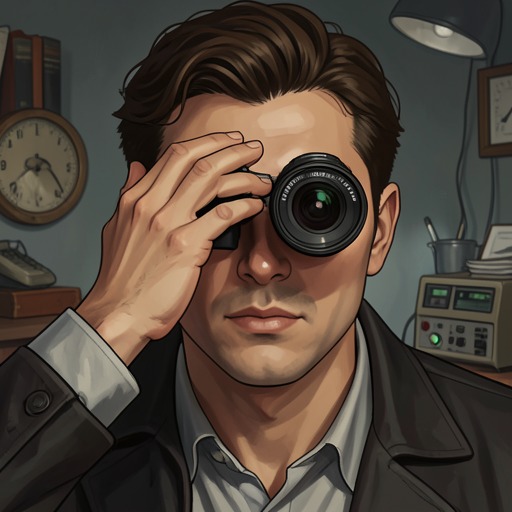
When filming begins, Ollie turns on the camera and explains that their first recorded section will be a conversation; later, he will take panning shots while Shay looks over the material. He says he will edit out what they discussed before the recording began. The first named ancestor he introduces is Rudolph Kaspersen, Shay’s great-great-great-grandfather. The file’s generations and photographs gradually turn a stranger’s research into a lineage Shay can examine for himself.
The discoveries also challenge the Irish identity Shay had associated with his upbringing. Ollie tells him that, as far as he can determine, Shay has no Irish blood. Shay recognizes that the name Ollie had supplied was not Irish, but still says the information makes him feel as if he has lost something. The emotional response is not an argument against the evidence; it registers the difference between learning a fact and being ready for what that fact changes.
The family tree extends beyond Rudolph. Ollie identifies Anna as briefly married to Shay’s sixth great-grandfather, explaining that this ancestor was three generations before Rudolph and belonged to another branch on Shay’s father’s side. He later names Joyce King, née Kasperson, as Shay’s great-great-grandmother. These women and the branching generations give the inquiry a scale beyond a single unexpected name, while Ollie reveals its findings in stages rather than as one completed account.
Parents, Grandparents, and Foster Care
At a later point, Shay and Ollie discuss Shay’s biological parents and the fire in which Francesca King died. Ollie has found reports from Francesca’s school years: she had no siblings, her parents were already dead, and she was an accomplished hockey player. Shay asks where he was when the fire happened. Ollie says an archived report contains no mention of a baby; Shay would have been only a few months old. The available account therefore does not answer every question about what happened to him in the period that followed.
The investigation does establish that Shay’s grandparents, Artur Nowack and Zofia Nowack, cared for him after Francesca died and fought to keep him. Ollie can only qualify why social services did not allow them to do so, suggesting it may have had something to do with Rudek Nowack. Shay was taken from his grandparents and placed in foster care; according to the chronology he gives, he spent six months there before being adopted at the age of two. The account connects his adoption to a prior separation from relatives who wanted him, rather than presenting foster care as the first point at which he was without family.
Shay asks whether his grandparents wanted him, and Ollie assures him that they did. The answer makes the recovered history more than a record of biological descent: it identifies a relationship of care and a struggle on his behalf. The grandparents had emigrated to England in the 1960s, settled in London, and run a cafe in Vauxhall for years. Their two sons later left the city and settled in Leeds. Their lives acquire particular weight for Shay not only as branches on a tree, but as the people who looked after him and tried to keep him after his mother’s death.
The Camera and the Limits of the Story
The graveside conversation brings the documentary’s presence into view. Shay wants to continue learning, but Ollie offers to turn off the camera and go somewhere else. He does not insist that the investigation continue as a filmed scene. After they move to a nearby bench, Shay realizes the camera is nowhere to be seen; he is absorbed in the account and does not ask about it. The exchange leaves room for the difference between wanting knowledge and consenting to every form in which that knowledge might be recorded.
A later edit preserves the scene at a distance: the final frames show Ollie and Shay sitting close together on a bench, their heads bowed and hands clasped. Ollie has edited the footage himself, but a second editor has made him more prominent than he wanted. The image does not resolve Shay’s unanswered questions about the period before foster care. Instead, it closes the documentary on the act of receiving the story with another person beside him.
Identity After the Discovery
The ancestry investigation changes what Shay can name about himself, but it does not make one lineage cancel another. Later, he considers using Rudzio Maloney as a performer’s name. He declines Rudzio Nowack, saying it is not his name to use, and explains that he cannot be all of one identity and none of the other. He has spent a long time coming to terms with his family history, yet remains connected to the people who raised him and will always be a Maloney.
For now, Shay chooses not to seek out surviving members of his biological family. That decision keeps the discovery from being mistaken for a reunion: the research gives him a history and a clearer account of separation, but it does not dictate what contact or belonging must mean. He quickly learns the Polish hurdy-gurdy once he understands what it is and where it comes from, another way the recovered heritage becomes available to him without requiring him to discard his existing name. The documentary’s closing image, with Shay and Ollie together on the bench, holds the two outcomes in tension: a newly visible biological past and a present shaped by chosen closeness and the family identity Shay elects to keep.